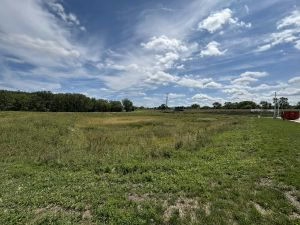
Successful natural area restoration relies on more than construction—it requires structured, ongoing monitoring to verify long-term success. In Hoffman Estates, Illinois, A3 Environmental Consultants (A3E) – known as Olson Ecological Solutions at the time – has been providing restoration monitoring services since 2024 to ensure that areas disturbed by the M-5 facility construction meet performance standards established by the U.S. Army Corps of Engineers Regional Permit Program.
For municipalities, developers, and government agencies, restoration monitoring transforms permit requirements into measurable outcomes. It tracks vegetation establishment, wetland and stream health, and overall site performance, ensuring that restoration objectives are achieved efficiently and defensibly.
Restoration Monitoring in Hoffman Estates, Illinois
The M-5 Maintenance Yard restoration project involved construction disturbances to the stormwater management system, requiring the construction of a detention basin and the relocation of a stream. Following initial stabilization and planting, A3E conducted comprehensive restoration monitoring to confirm that restoration activities were progressing according to permit-defined performance standards.
Monitoring included multiple site visits per year, during which ecologists assessed vegetative communities and overall site conditions. Data collected in the field informed detailed reports documenting site status and offering recommendations to keep restoration progress on track. Adaptive management strategies, including invasive species control managed by Tallgrass Restoration and the Illinois Tollway, were implemented as needed.
Process and Methodology
A3E’s approach follows structured, repeatable methodology aligned with federal and regional guidelines. For Hoffman Estates, monitoring focused on quantitative and qualitative evaluation of vegetation establishment, hydrologic function, and wetland/stream performance.
Reports based on two site visits were produced each year, providing clear documentation for regulatory compliance. Adaptive management strategies were recommended whenever monitoring indicated potential deviations from target performance metrics. This proactive approach ensures that restoration efforts remain on schedule and aligned with U.S. Army Corps of Engineers requirements.
Business and Regulatory Value of Monitoring
Restoration monitoring delivers tangible business and regulatory benefits. By tracking progress and documenting compliance, project owners minimize risk and protect investments. For the M-5 Maintenance Yard project, two years of monitoring have demonstrated substantial progress toward performance goals, with an estimated one year remaining to achieve final compliance.
Clear reporting and actionable recommendations allow agencies and stakeholders to confidently verify that restoration objectives are being met. This prevents costly rework, avoids regulatory enforcement actions, and ensures that ecological restoration is successful in both function and form.
Local Considerations for Restoration in Hoffman Estates
Hoffman Estates’ urbanized landscape, altered hydrology, and regulatory oversight require site-specific monitoring approaches. Seasonal variability, stormwater impacts, and invasive species pressures are accounted for in A3E’s methodology, ensuring that monitoring reports reflect actual site conditions rather than generic assessments.
By coordinating closely with local contractors and regulatory agencies, including Tallgrass Restoration and the Illinois Tollway, A3E ensures monitoring aligns with on-the-ground restoration efforts and permit expectations.
Conclusion
Restoration monitoring is the cornerstone of successful natural area restoration. In Hoffman Estates, Illinois, A3E’s work at the M-5 Maintenance Yard demonstrates that ongoing fieldwork, rigorous reporting, and adaptive management are essential to achieving performance standards.
Contact A3 Environmental Consultants to learn how restoration monitoring can support your project, ensure compliance, and deliver measurable ecological success.