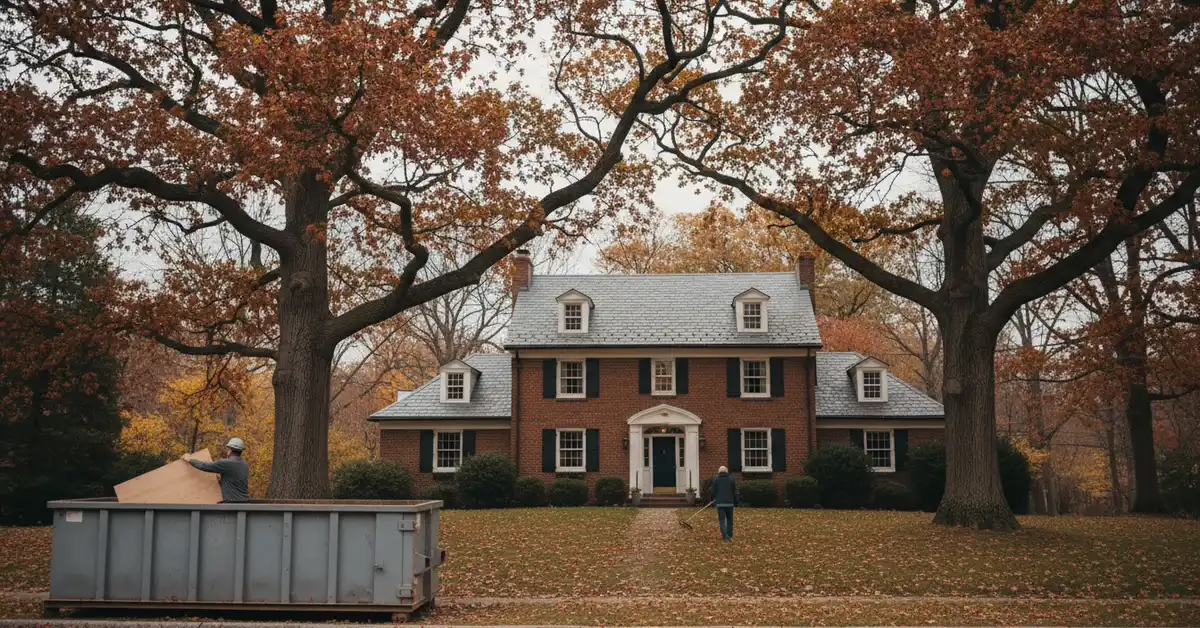
A tree removal permit is a town’s written approval to cut down a protected tree, and in Chicago’s north suburbs a teardown or rebuild often needs one before the demolition crew arrives. Illinois has no statewide tree removal permit for private property that A3 Environmental Consultants (A3E) has found. The rules are local, and they vary a lot. Highland Park requires a permit for any tree 8 inches in diameter at breast height (DBH) or larger and fines $4,000 per Heritage tree. Evanston’s rules kick in for exterior work within 25 feet of any tree. Northbrook regulates trees from 6 inches DBH. This guide compares seven north suburban towns, explains when the permit needs a certified arborist’s survey and shows builders how to avoid fines, replacement costs and schedule delays.
Do You Need a Tree Removal Permit in Illinois?
At the state level, no. A3E found no Illinois statute that requires a permit or survey before a private owner removes a tree. The state does step in when someone cuts trees they do not own: under the Illinois Wrongful Tree Cutting Act (740 ILCS 185), the owner can recover three times the stumpage value of the trees.
Everything else is set by cities, villages and counties. On a teardown, the tree rules usually ride along with the building or demolition permit, so a builder who skips the tree review can stall the whole project. In unincorporated Lake County, the county’s own development code applies. Inside a town, the town’s code governs, and each town writes its own tree removal permit rules.
Tree Removal Permit Rules Town by Town
The table below summarizes the tree removal permit rules A3E reviewed for each town. Codes change, so confirm the current rules with the town before you file.
| Town | When you need a permit | Survey or plan with construction | Fines, replacement or fees |
|---|---|---|---|
| Highland Park | Any tree 8 inches DBH or larger (15 inches for multi-stem) | Survey of all trees 6 inches and up in the construction zone, plus a preservation fence plan, reviewed by the City Forester | $1,000 per Protected or Key tree, $4,000 per Heritage tree, $1,000 for drip-line work |
| Lake Forest | Heritage trees 18 inches DBH and up, trees 10 inches and up in a front or corner side yard, any tree on a lot with a pending grading, building or demolition permit, and (per the city form) removal of more than six trees 4 inches and up | Tree survey of all trees 8 inches and up (and clusters of six or more trees 4 inches and up) with location, size, species and condition, each tagged on site | Up to $750 per DBH inch |
| Evanston | Exterior work within 25 feet of any tree (private-tree rules since June 1, 2024) | Plan showing public trees 2 inches and up and private trees 6 inches and up, including neighbors’ trees within 25 feet | Replacement at 75 to 175 percent of the removed tree’s DBH, depending on species group and size, or a fee in lieu ($275 per replacement tree in 2026) |
| Northbrook | Trees 6 inches DBH and up (12 inches combined for multi-stem) | Protection plan at 1 inch to 20 feet with DBH, species, condition and fate; 4-foot fencing | Inch-for-inch replacement |
| Wilmette | Any private tree 6 inches DBH or larger, any replacement tree, and any parkway tree (right-of-way permit) | Tree survey and tree protection plan before demolition, new construction or an addition that grows lot coverage 50 percent or more; the survey covers trees 6 inches and up on the lot and within 15 feet of the lot lines, plus all parkway trees, and the village manual requires an ISA Certified Arborist | $50 to $7,500 per offense (each day counts separately), plus 1 to 4 replacement trees or $500 to $2,000 per tree in lieu; Heritage trees are replaced inch for inch |
| Glenview | Landmark trees on private property: 8 inches DBH and up for Class A and B species (oaks, hickories, maples and similar), 10 inches for Class C; any public or parkway tree, any size | Construction activity protection plan with the permit; new homes, additions, demolitions and land clearing need an inventory of every private tree 8 inches and up and every public tree, with species, DBH, condition, critical root zone and fencing | At least $1,000 per violation (each day counts separately), plus replacement trees by size and class or $1,250 per tree in lieu on existing single-family lots |
| Park Ridge | Private trees larger than 10 inches DBH (15 inches combined for multi-stem trees), plus any parkway tree | Tree Preservation Plan at 1 inch to 20 feet with every building or site work permit, showing the location, size and species of each protected tree | At least $500 per DBH inch for removal without a permit, plus 1 to 4 replacement trees for each tree over 10 inches |
Sources: Highland Park, Lake Forest (Ch. 99), Evanston, Northbrook, Wilmette, Glenview, Park Ridge.
Heritage Trees and Their Fines
The biggest fines in these towns attach to the biggest trees. Highland Park is the clearest example. Its code names Key trees, including oaks, hickories, sugar maple and walnut, and a higher Heritage class by species and size:
- Oak, 30 inches DBH and up
- Hickory, 20 inches DBH and up
- Walnut, 30 inches DBH and up
- American elm, 40 inches DBH and up
A request to remove a Heritage tree goes to the Zoning Board of Appeals. The fines run $1,000 per Protected or Key tree and $4,000 per Heritage tree, plus $1,000 for work inside a tree’s drip line. On a wooded teardown lot with several large oaks, those numbers add up fast.
Lake Forest prices its penalty by size: up to $750 per inch of DBH. Park Ridge sets a floor instead: at least $500 for every inch of DBH removed without a permit. On a large tree, either adds up quickly.
The safest move is to know which trees are Heritage or Key trees before the demolition plan is drawn and before you apply for the tree removal permit.
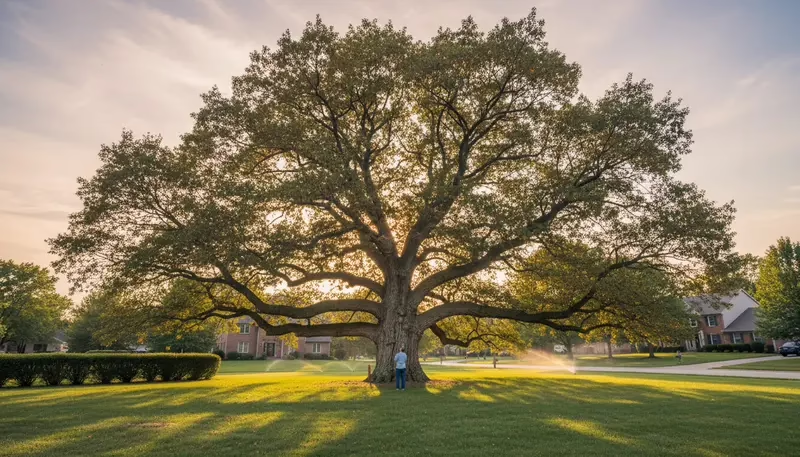
Large oaks and hickories carry the highest fines on the North Shore.
When the Permit Needs a Certified Arborist’s Survey
For a teardown, the tree removal permit often depends on a tree survey: a tagged, measured inventory of the trees on the lot, with species, DBH, condition and location. Here is how the towns above handle it:
- Highland Park: the building permit needs a survey of all trees 6 inches and up in the construction zone and a preservation fence plan, reviewed by the City Forester.
- Lake Forest: development applications need a tree survey of every tree 8 inches DBH and up, plus clusters of six or more trees 4 inches and up, with location, size, species and condition, and each tree tagged on site. Every removal application also needs a stamped plat of survey.
- Evanston: a removal request outside of construction “should include information from a Certified Arborist.”
- Northbrook: § 25-14 calls for a protection plan at 1 inch to 20 feet showing DBH, species, condition and the fate of each tree.
- Wilmette: a teardown, new home or large addition needs a tree survey and tree protection plan before the demolition or building permit, and the village’s Tree Regulations Manual says an ISA Certified Arborist must prepare the survey.
- Glenview: new homes, additions and demolitions need a tree inventory and protection plan.
- Park Ridge: every building or site work permit needs a Tree Preservation Plan drawn at 1 inch to 20 feet.
Farther west in Lake County, the Village of Libertyville spells it out on its demolition checklist: a “tree survey signed by certified arborist.” A3E completed a tree survey in Libertyville in March 2026, working with Davey Resource Group, whose arborist led the inventory of 143 trees in one field day.
A3E’s tree survey work to date is in Lake and McHenry counties, including a 225-tree survey in Algonquin that was part of a wetland delineation and permitting job. The same ISA Certified Arborist method applies on a North Shore lot: numbered aluminum tags, sub-meter GPS, DBH at 4.5 feet, a 1 to 6 condition rating with notes, and a data table, GPS shapefile and summary letter the town can review.
Tree Protection Fencing Before Demolition
On a teardown, roots are at risk from the first day, when equipment drives over them or a dumpster lands inside a drip line. That is why towns want fencing up before the demolition starts. Plan the fence at the same time as the tree removal permit.
- Northbrook requires 4-foot tree protection fencing.
- Lake Forest requires 4-foot fencing on steel posts before it issues grading, building or demolition permits.
- Highland Park asks for a preservation fence plan with the building permit and fines $1,000 for work inside the drip line.
- Libertyville requires drip-line fencing, or 6 inches of mulch covered by two layers of 3/4-inch plywood.
On A3E sites, the arborist adds simple field rules: keep equipment outside the drip line, manage soil compaction, use vertical mulching where soil is already compacted, and monitor a stressed tree instead of removing it when it can recover. In one case from A3E’s arborist’s field experience, a mature, healthy shade tree next to new construction was nearly cut down after equipment compacted its root zone. The right call was to protect it, mulch and monitor.
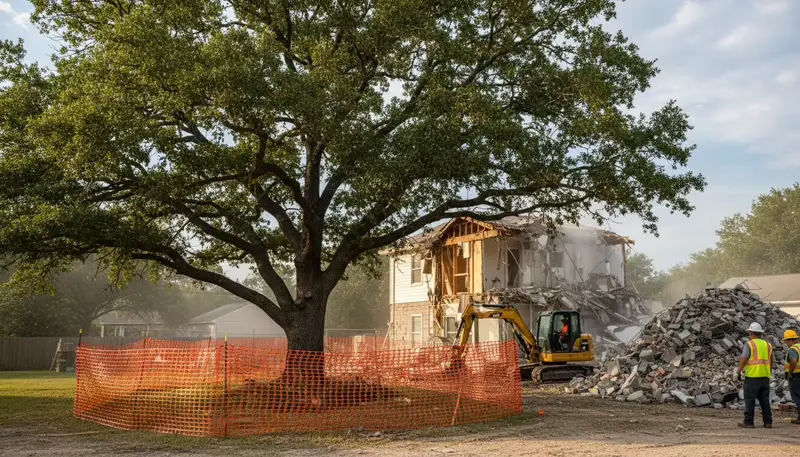
Fencing goes up before the first piece of equipment arrives.
Replacement Trees and Fees in Lieu
A tree removal permit usually comes with a replacement bill. Towns either require new trees on site or accept a fee in lieu. Here is how three towns calculate it:
- Evanston multiplies the removed tree’s DBH by a factor of 75 to 175 percent, depending on the species group and size, or charges $275 per replacement tree in lieu. For example, removing a 21-inch elm means planting 13 trees or paying $3,609.
- Northbrook requires inch-for-inch replacement.
- Libertyville requires 3, 2 or 1 replacement trees depending on the tree’s group, or $350 per tree in lieu.
Replacement is where a good survey pays for itself on a tree removal permit. When the survey shows which trees are healthy, which are already dead or hazardous, and which are invasive, the builder can design around the trees worth saving and document the rest.
Frequently Asked Questions
Do I need a tree removal permit to tear down a house on the North Shore?
Often, if protected trees are on or near the lot. Highland Park ties its tree survey to the building permit, and Evanston’s rules apply to exterior work within 25 feet of any tree. Check the town’s code before you file for the demolition permit.
How much is the fine for removing a Heritage tree in Highland Park?
Highland Park fines $4,000 per Heritage tree and $1,000 per Protected or Key tree. Work inside a tree’s drip line can bring another $1,000 fine.
Does a tree removal permit cover my neighbor’s trees?
It can. Evanston’s construction plan must show neighbors’ trees within 25 feet of the work. Algonquin, in McHenry County, also requires protection of neighbors’ trees within 10 feet.
Who prepares the tree survey for a tree removal permit?
Codes vary. Evanston asks for information from a Certified Arborist, and Libertyville’s demolition checklist asks for a tree survey signed by a certified arborist. A3E prepares tree surveys with an ISA Certified Arborist.
A3E project fingerprint
- Projects: Libertyville Tree Survey; Woods Creek Force Main Replacement
- Cities: Libertyville, Illinois; Algonquin, Illinois
- Counties: Lake County; McHenry County
- Coordinates: Libertyville: [coordinates needed]; Algonquin: [coordinates needed]
- Staff: Thomas Casey, ISA Certified Arborist; Colleen Stull, Senior Project Manager
Planning a teardown or rebuild? A3E puts an ISA Certified Arborist on your lot to deliver the tree survey your tree removal permit needs, backed by the same team that handles ecological services and permitting. Request a quote or call us at (888) 405-1742.

We Fix Gnarly Environmental Problems
Reviewed by Thomas Casey, ISA Certified Arborist