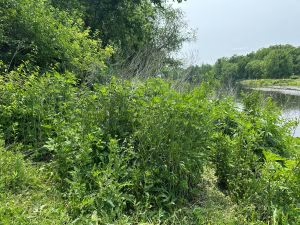
Restoration monitoring is not the glamorous part of a construction project, but it is often the part that determines whether a project ultimately succeeds or becomes a regulatory headache. In Naperville, Illinois, where development frequently intersects with streams, wetlands, and other regulated aquatic resources, restoration monitoring plays a critical role in keeping projects compliant long after construction crews leave the site. When permitted impacts occur, regulators expect proof that mitigation and restoration efforts are functioning as intended, not just initially, but over multiple growing seasons.
For developers, municipalities, and government agencies, restoration monitoring is the mechanism that translates permit conditions into defensible data. It documents whether restored wetlands and streambanks are meeting performance standards, whether vegetation is establishing properly, and whether adaptive management is needed to keep projects on track. Without it, even well-designed restoration projects can fall short of regulatory expectations.
Restoration Monitoring in Naperville, Illinois
Restoration monitoring in Naperville presents unique challenges due to the area’s highly managed waterways, urbanized watersheds, and stringent permitting requirements for Special Management Areas and aquatic resources. Projects that disturb streams or wetlands typically require mitigation, followed by several years of post-construction monitoring to demonstrate compliance with permit performance standards.
A3 Environmental Consultants provided services for the Naperville South-Central Interceptor Stabilization project, as a subcontractor to Strand Associates, after construction activities in 2020 resulted in permitted disturbances to wetlands and streambanks. Following initial stabilization and planting, A3E conducted comprehensive restoration monitoring across the entire site. This included multiple site visits each year to evaluate vegetative communities, assess tree and shrub health, and document wetland size and quality.
Vegetative community data collected in the field was used to evaluate whether the restored areas were trending toward success criteria according to DuPage County Stormwater permit. Rather than relying on visual observations alone, monitoring focused on measurable indicators tied directly to regulatory performance standards. These efforts ensured that restoration progress could be clearly demonstrated to reviewing agencies throughout the monitoring period.
Process and Methodology
Effective restoration monitoring follows a structured, repeatable methodology aligned with permit conditions, agency guidance, and applicable standards. In Naperville and across northern Illinois, monitoring programs are often shaped by U.S. Army Corps of Engineers permits, Illinois EPA requirements, and local municipal ordinances governing aquatic resources.
For the Naperville Interceptor project, monitoring involved scheduled site visits multiple times per year. During these visits, A3E ecologists collected quantitative and qualitative data on vegetation establishment, species composition, and invasive pressure, hydrologic conditions, and overall wetland quality. Tree and shrub survival and vigor were tracked to ensure long-term stability of the restored vegetative communities. When monitoring results indicated potential issues, adaptive management strategies were developed and documented to correct course before small problems became compliance failures.
In addition to monitoring existing conditions, A3E conducted a full aquatic resource delineation and prepared a delineation report comparing pre-construction wetland size and quality to post-construction conditions. This allowed for a defensible, apples-to-apples comparison that regulators expect when evaluating mitigation success.
Business and Regulatory Value of Monitoring
From a business perspective, monitoring protects investments by reducing regulatory risk. Permits typically require years of monitoring and reporting, and failure to meet performance standards can result in extended monitoring periods, additional mitigation costs, or enforcement actions. Restoration monitoring provides early warning when restoration trajectories are not aligning with permit expectations.
Between 2021 and 2026, A3E’s vegetation monitoring and reporting efforts for the Naperville Interceptor project helped demonstrate substantial progress toward restoration goals. By producing detailed monitoring reports, A3E provided clear documentation of site conditions, regulatory compliance, and recommended corrective actions when necessary. This proactive approach allowed the project to remain aligned with permit requirements rather than reacting after deficiencies were identified by agencies.
For developers and public agencies alike, restoration monitoring is not just about environmental stewardship; it is about schedule certainty, budget control, and maintaining good standing with regulators.
Local Considerations for Restoration in Naperville
Naperville’s location within a heavily developed region of northern Illinois means restoration sites are often influenced by upstream land use, altered hydrology, and invasive species pressure. Restoration monitoring programs must account for these realities and adjust expectations and management strategies accordingly.
Local agencies expect restoration monitoring to reflect site-specific conditions rather than generic checklists. This includes acknowledging seasonal variability, documenting weather-related impacts, and demonstrating that monitoring conclusions are grounded in data collected on-site. Familiarity with local permitting agencies and regional ecological conditions is essential for producing monitoring reports that withstand regulatory scrutiny.
Conclusion
Restoration monitoring is the long game of aquatic resource mitigation. In Naperville, Illinois, it is the difference between a restoration project that merely looks complete and one that is demonstrably successful under permit requirements. Through consistent fieldwork, defensible reporting, and adaptive management, restoration monitoring ensures that impacts to wetlands and streams are responsibly addressed.
If your project involves permitted impacts to aquatic resources, experienced restoration monitoring can keep your project compliant, on schedule, and out of regulatory trouble.
Contact A3 Environmental Consultants to discuss restoration monitoring strategies tailored to your project and permit requirements.