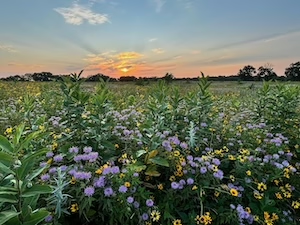
A wetland mitigation bank is only as successful as its planning, performance standards, and long-term monitoring. For municipal and government stakeholders, the difference between a functional public asset and a regulatory headache often comes down to early technical decisions and sustained agency coordination. In Afton, Wisconsin, the Bass Creek Wetland Mitigation Bank demonstrates how a properly designed wetland mitigation bank can meet regulatory requirements while delivering tangible ecological and community benefits.
Since 2013, A3E Environmental has supported wetland mitigation bank development with a focus on compliance, performance standards, and long-term viability. The Bass Creek project highlights how disciplined methodology and adaptive management can accelerate success without cutting corners.
Wetland Mitigation Bank Development in Afton, Wisconsin
The Bass Creek Wetland Mitigation Bank was developed to offset permitted wetland impacts while restoring high-functioning wetland resources within the same watershed. Located in Afton, Wisconsin, the site presented both opportunities and constraints typical of Midwestern wetland restoration projects, including hydrology management, planting survivability, and agency performance expectations.
A3 Environmental Consultants played an integral role in advancing the wetland mitigation bank from concept to performance compliance. Initial efforts focused on assessing site conditions and refining restoration objectives to align with state and federal mitigation banking guidance. Existing planting plans were enhanced to better meet performance standards related to vegetation coverage, species diversity, and long-term resilience.
The wetland mitigation bank was planted in 2014 in partnership with Tallgrass Restoration. From that point forward, A3E led monitoring and reporting efforts to track restoration progress and confirm that the site was trending toward regulatory success. This long-term involvement allowed issues to be identified early and addressed through adaptive management rather than corrective enforcement.
Notably, performance standards established for Year Three were achieved in Year Two, with formal confirmation in 2017. For municipal stakeholders, early attainment of performance standards reduces long-term risk and improves credit reliability within a wetland mitigation bank.
Process and Methodology
Successful wetland mitigation bank implementation requires more than installation. It demands a structured process grounded in regulatory standards and ecological realities. A3E’s methodology for the Bass Creek Wetland Mitigation Bank followed a phased approach consistent with Wisconsin Department of Natural Resources and U.S. Army Corps of Engineers expectations.
Site assessments evaluated existing hydrology, soils, and vegetation to confirm suitability for wetland restoration. Planting plans were refined to improve survivability and functional performance, with species selection tailored to site conditions rather than theoretical targets.
Post-construction, A3E led annual monitoring efforts, documenting vegetation establishment, invasive species pressures, and hydrologic function. Monitoring data were interpreted against approved performance standards and compiled into formal monitoring reports submitted to regulatory agencies.
Adaptive management strategies were developed and implemented as needed, with agency coordination serving as a critical component of the process. A3E worked directly with the Wisconsin Department of Natural Resources and the U.S. Army Corps of Engineers to review monitoring results, propose planting plan adjustments, and secure agency acceptance. This proactive communication reduced delays and ensured that the wetland mitigation bank remained compliant as conditions evolved.
Business and Public Value
For municipalities and government agencies, a wetland mitigation bank represents both an environmental investment and a risk management tool. The Bass Creek Wetland Mitigation Bank delivers measurable public benefits while maintaining regulatory certainty.
Ecologically, the restored wetlands provide stormwater filtration, detention, and infiltration, reducing downstream flooding risks. Improved water quality has contributed to a cleaner creek system and enhanced recreational opportunities, including better fishing conditions. The site also supports pollinator habitat, reinforcing broader conservation objectives.
From a regulatory perspective, early achievement of performance standards shortened the path to credit viability and reduced long-term monitoring uncertainty. For projects relying on mitigation credits, this reliability matters. Since services began in 2013 and continue through the present, the wetland mitigation bank has demonstrated sustained compliance rather than short-term success.
Equally important is the role of trusted technical partners. By coordinating closely with Tallgrass Land Conservation and regulatory agencies, A3E functioned as a strategic partner rather than a transactional consultant. That distinction is often what separates durable mitigation banks from marginal ones.
Local and Regional Considerations
Wetland mitigation bank projects in southern Wisconsin face region-specific challenges, including variable precipitation patterns, freeze-thaw cycles, and invasive species pressures. In Afton and the surrounding region, successful mitigation banking depends on adaptive planting strategies and long-term stewardship.
Regulatory coordination with the Wisconsin Department of Natural Resources and the U.S. Army Corps of Engineers is also critical. Local expectations around monitoring frequency, reporting detail, and adaptive management must be addressed early to avoid project delays.
The Bass Creek Wetland Mitigation Bank reflects an approach grounded in local conditions rather than generic restoration templates. By aligning ecological goals with regional realities, the project achieved compliance while delivering lasting public value.
Conclusion
A wetland mitigation bank should do more than satisfy permit conditions. When properly executed, it becomes a resilient environmental asset that supports infrastructure, ecosystems, and community goals. The Bass Creek Wetland Mitigation Bank in Afton, Wisconsin illustrates how disciplined planning, rigorous monitoring, and proactive agency coordination can accelerate success.
If your municipality or agency is evaluating wetland mitigation bank opportunities or needs technical support for permitting, monitoring, or adaptive management, A3 Environmental Consultants brings the experience to guide projects from concept through long-term compliance.
Contact A3E to discuss how a wetland mitigation bank can work for your jurisdiction.
