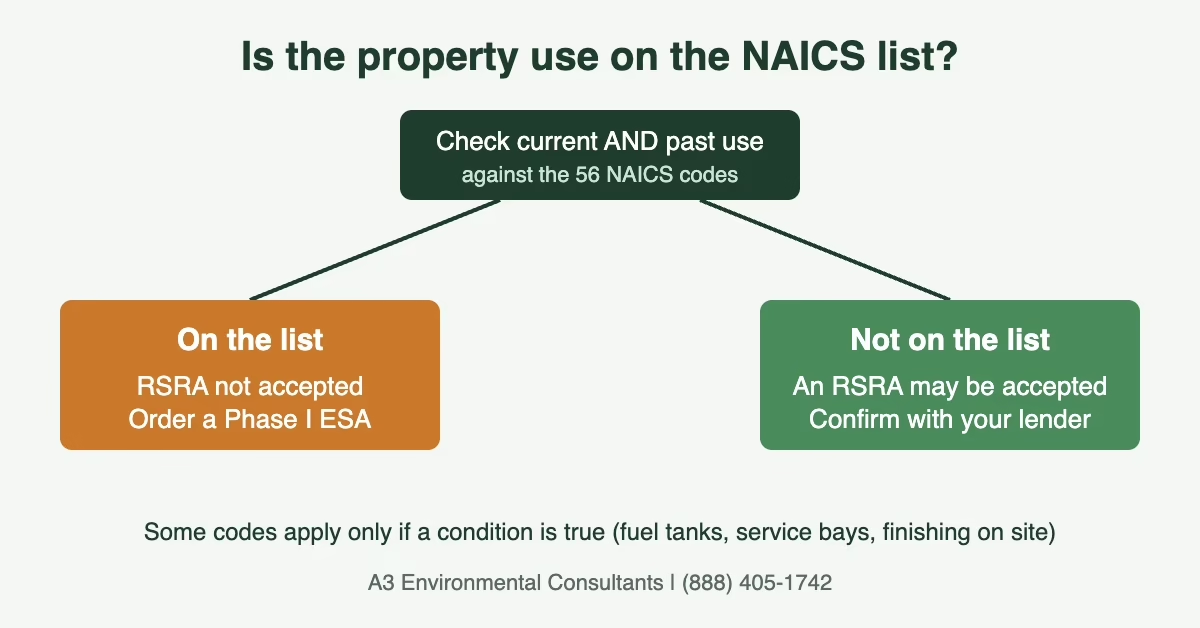
The NAICS codes for environmentally sensitive industries are the 55 industry codes below. If a property’s current or past use falls under one of them, a lender will not accept a Record Search With Risk Assessment (RSRA) as the environmental due diligence for a commercial loan. Some codes are on the list outright. Others count only when something specific is present, such as fuel tanks or service bays. Find your code among the environmentally sensitive industries in the two tables, read the condition, and you will know which kind of assessment to order.
What Are Environmentally Sensitive Industries?
Environmentally sensitive industries are lines of business that handle, store or release the kinds of materials that leave contamination behind: fuels, solvents, metals, chemicals, waste. Lenders sort them with NAICS (North American Industry Classification System) codes, the numbering system that tags every business with an industry.
The list matters because of what it rules out. When the current or past use of a property is on it, a records-only review is not enough. If you are buying commercial property and need environmental due diligence for the loan, check the property against this list of environmentally sensitive industries before you order anything. Ordering the wrong product costs you time during the one stretch of a deal when time is short.
How Lenders Use These NAICS Codes
A lender looks at what the property is used for today and what it was used for in the past. Past use is the part buyers miss. A vacant lot, a restaurant or an office can sit on ground that once held a dry cleaner or a gas station, and the old use still counts.
If the use is on the list, the usual next step is a full Phase I Environmental Site Assessment. If it is not, a lighter product may be accepted, such as the RSRA or a Transaction Screen. Our comparison of the RSRA and the Phase I covers how they differ. Your lender has the final word on what it accepts, so ask before you order.
NAICS Codes for Environmentally Sensitive Industries That Always Apply
These 26 environmentally sensitive industries are on the list with no conditions. If the current or past use of the property falls under one, plan on more than an RSRA.
| NAICS code | Industry |
|---|---|
| 211 | Oil & Gas Extraction |
| 212 | Mining (Except Oil & Gas) |
| 213 | Support Activities for Mining |
| 237 | Heavy & Civil Engineering Construction |
| 322 | Paper Manufacturing |
| 323 | Printing & Related Support Activities |
| 324 | Petroleum & Coal Products Manufacturing |
| 325 | Chemical Manufacturing |
| 327 | Nonmetallic Mineral Products Manufacturing |
| 331 | Primary Metal Manufacturing |
| 336 | Transportation Equipment Manufacturing |
| 42314 | Motor Vehicle Parts (Used) Merchant Wholesalers |
| 4235 | Metal & Mineral Merchant Wholesaler |
| 42393 | Recyclable Material Merchant Wholesaler |
| 4246 | Chemical & Allied Products Merchant Wholesalers |
| 4247 | Petroleum & Petroleum Products Merchant Wholesalers |
| 481 | Air Transportation |
| 482 | Rail Transportation |
| 486 | Pipeline Transportation |
| 54138 | Testing Laboratories |
| 56171 | Exterminating & Pest Control Services |
| 562 | Waste Management & Remediation Services |
| 71391 | Golf Courses & Country Clubs |
| 71392 | Skiing Facilities |
| 71393 | Marinas |
| 8113 | Commercial & Industrial Machinery & Equipment Repair & Maintenance |
Environmentally Sensitive Industries With Conditions
These 29 codes are on the list only when the condition in the right-hand column is true. A food manufacturer with no fuel tanks is treated differently from one with them. Read the condition against what is actually on the site, and check past use as well as current use.
| NAICS code | Industry | When it applies |
|---|---|---|
| 311 | Food Manufacturing | If fuel tanks present |
| 312 | Beverage & Tobacco Product Manufacturing | Except breweries, 31212 |
| 313 | Textile Mills | Not required if sewing, weaving, or hemming only |
| 314 | Textile Product Mills | Not required if sewing, weaving, or hemming only |
| 316 | Leather & Allied Product Manufacturing | Not required if assembly only |
| 321 | Wood Product Manufacturing | If finishing occurs on site |
| 326 | Plastics & Rubber Products Manufacturing | Not required if assembly only |
| 332 | Fabricated Metal Product Manufacturing | Not required if assembly only |
| 333 | Machinery Manufacturing | Not required if assembly only |
| 334 | Computer & Electronic Product Manufacturing | Not required if assembly only |
| 335 | Electrical Equipment, Appliance & Component Manufacturing | Not required if assembly only |
| 337 | Furniture & Related Manufacturing | If finishing occurs on site |
| 339 | Miscellaneous Manufacturing | Only required if hazardous materials are involved |
| 42311 | Automobile & Other Motor Vehicle Merchant Wholesalers | If service bays present |
| 441 | Motor Vehicle and Parts Dealers | If service bays present |
| 457 | Gasoline Stations & Fuel Vendors | Not required for propane or firewood dealers |
| 484 | Trucking | If service bays, truck washing, or fuel tanks present |
| 488 | Support Activities for Transportation | If fuel tanks are present or if repairs or maintenance is performed on site |
| 53212 | Truck, Utility Trailer, and RV (Recreational Vehicle) Rental & Leasing | If repairs, maintenance or vehicle washing are performed onsite |
| 53241 | Construction, Transportation, Mining & Forestry Machinery & Equipment Rental & Leasing | If repairs, maintenance or vehicle washing are performed onsite |
| 53249 | Other Commercial & Industrial Machinery & Equipment Rental & Leasing | If repairs, maintenance or vehicle washing are performed onsite |
| 6221 | General Medical & Surgical Hospitals | If fuel tanks are present |
| 713990 | Other Recreational Industries | Indoor and outdoor shooting ranges only |
| 7212 | RV (Recreational Vehicles) Parks & Recreational Camps | If fuel tanks are present or if vehicle repairs or maintenance is performed onsite |
| 8111 | Automotive Repair & Maintenance | Except for “car wash only” facilities, for which a Transaction Screen is an acceptable starting point |
| 8112 | Electronic & Precision Equipment Repair & Maintenance | Not required if assembly only |
| 8122 | Death Care Services | Unless no embalming or cremation at the Property |
| 8123 | Laundry & Dry Cleaning Services | If dry cleaning operations have ever existed on site |
| 812921 | Photofinishing Laboratories | Except one hour |
The list comes from Appendix 6 of SBA SOP 50 10 8.1 (effective October 1, 2026), which adds one rule for every industry: “A Phase I should always be obtained if the business sells, supplies or dispenses fuel, gasoline, heating oil, even if the NAICS code for the business is not identified on this list.”
Which Assessment Does Your Property Need?
Match the property to the lists above, then to the product:
- Use is on the list: a Phase I ESA is the usual requirement. Do not order an RSRA for it.
- Use is on the list only with a condition, and the condition is not met: an RSRA may be accepted. Confirm with your lender and write down why the condition does not apply.
- Use is not on the list: an RSRA is generally accepted, and our desktop report versus RSRA guide shows how it compares with a database report.
- The only use is a car wash: the list makes an exception for car wash only facilities, where a Transaction Screen is an acceptable starting point.
The RSRA scope-of-work page lists the price as $850 with a 6 to 8 day turnaround. Phase I pricing depends on the property, so ask for a quote.
Project Example: A Former Auto-Repair Shop in Chicago
In 2020, A3E performed a Phase I ESA on a vacant auto repair shop and former restaurant in Chicago. Auto repair is on the list above, and the site showed why: about 35 years of auto repair use, a 1959 fuel-oil underground storage tank in the city’s tank records, a vent pipe with a fuel-oil odor, a solvent drum with staining and four in-ground hydraulic lifts. A3E identified these as RECs and recommended a soil and groundwater investigation (Phase II ESA).
- Project: Phase I ESA on a former auto repair shop and restaurant (2020)
- City: Chicago, Illinois
- Outcome: RECs identified; Phase II soil and groundwater investigation recommended
Frequently Asked Questions
What are NAICS codes for environmentally sensitive industries?
They are the industry classification codes lenders use to flag businesses that are likely to have caused contamination, such as gas stations, dry cleaners, metal manufacturers and waste services. This page lists 56 of them. If a property’s current or past use matches one, an RSRA is not enough for the loan.
Can I use an RSRA if my property is on the list?
No. An RSRA cannot be used when the current or past use of the property is on this list. Order a Phase I ESA instead, and confirm the requirement with your lender.
Does past use count, or only what the property is today?
Both count. A property that is a restaurant today but was a gas station or dry cleaner in the past still has a listed use in its history.
What if my industry is only listed with a condition?
The code applies only when the condition is true. For example, food manufacturing (311) is on the list if fuel tanks are present, and trucking (484) is on it if there are service bays, truck washing or fuel tanks. If the condition does not apply, a lighter assessment may be accepted, but the lender decides.
Get the Right Assessment for Your Loan
Not sure where your property falls? A3 Environmental Consultants (A3E) can sort it out before you pay for the wrong product. We keep your project confidential, we meet or exceed Small Business Administration (SBA) Standard Operating Procedure (SOP) 50 10 8.1 (effective October 1, 2026), Appendix 6 on commercial and industrial property, and our assessments meet the requirements of commercial lenders and agencies such as the SBA, Housing and Urban Development (HUD) and the United States Department of Agriculture (USDA). Request an RSRA quote, or request a Phase I ESA quote. You can also call (888) 405-1742 or email [email protected].
Reviewed by Dave McCoy, P.G., Director of Operations, A3 Environmental Consultants.

We Fix Gnarly Environmental Problems
