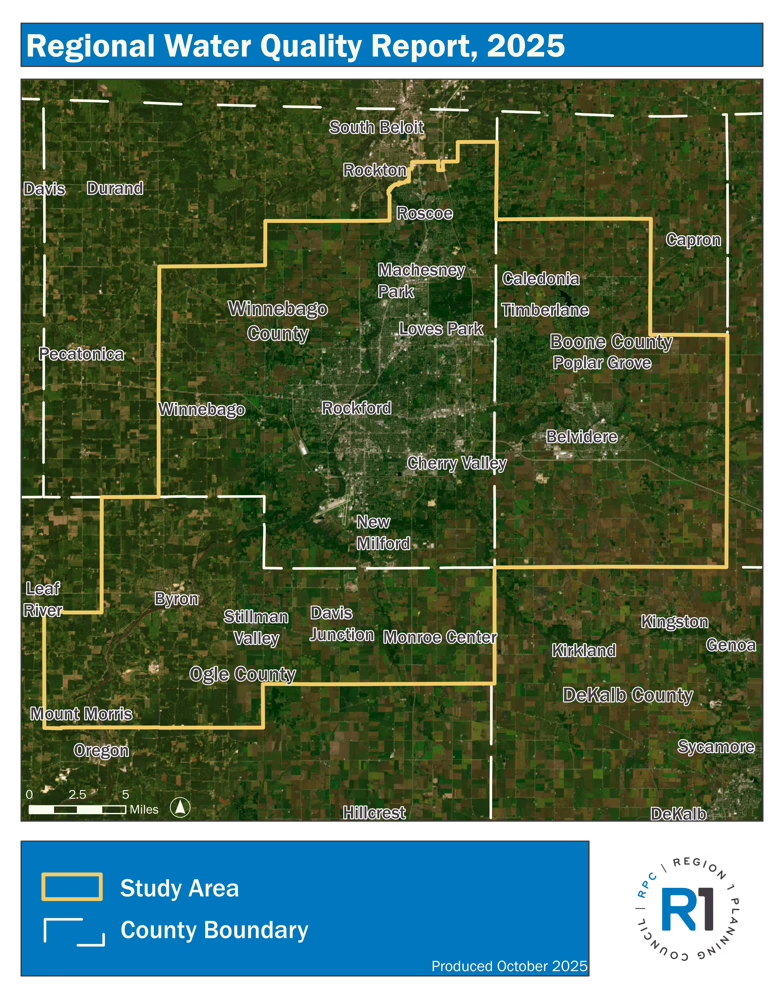
Clean water supports public health, economic stability, recreation, and ecological integrity. In 2025, A3 Environmental Consultants (A3E) partnered with the Region 1 Planning Council (R1) to develop a comprehensive Water Quality Report – Our Our Water’s Health in the Rockford Region – for the Rockford Metropolitan Area. Spanning parts of Boone, Ogle, and Winnebago counties, this effort compiled and translated complex groundwater, surface water, and drinking water data into clear, accessible resources for municipal officials and the general public. The results are two separate but complementary documents: a detailed technical support document and a simplified, public-facing overview. Together, these deliverables provide both depth and accessibility for municipal officials and the general public across the Rockford Region.
Water Quality Report for the Rockford Metropolitan Area
From June through December 2025 and publishing in early 2026, A3E provided project management, strategic planning, stakeholder engagement, report writing and editing, and coordination of graphic design across R1’s service area – the Rockford Metropolitan Planning Area (MPA) – which serves a population of over 300,000 people.
Rebecca Olson served as Project Manager, with Ella Iaderosa and Daisy Orellana leading report development. Place Foundry provided groundwater technical expertise graphic design services.
The project produced two distinct documents:
- Regional Water Quality Technical Support Document
- Regional Water Quality Overview (Public-Facing Summary)
While both documents are grounded in the same research, they serve different audiences and purposes.
The Technical Support Document compiles and synthesizes existing studies, monitoring data, regulatory standards, and regional planning resources related to the interconnected water systems of the Rockford Region. It is structured for planners, engineers, municipal staff, and technical reviewers who require defensible detail and source documentation.
The Overview Report translates that same body of research into accessible language, clear graphics, and structured explanations suitable for elected officials, stakeholders, and residents. It functions as a communication tool—accurate, digestible, and designed for public distribution.
Both documents center on a shared foundation: a rigorous Water Quality Report process designed to inventory, evaluate, and clarify regional water conditions.
Methodology and Regulatory Framework
The Water Quality Report process was structured in three primary phases: inventory, evaluation and synthesis, and documentation.
Phase 1: Inventory
The team identified potential data sources, gathered relevant datasets, reconciled overlapping information, and mapped regional patterns. The inventory evaluated:
• Groundwater quality and availability
• Surface water conditions across major watersheds
• Drinking water compliance and emerging contaminant concerns
• Pollutant sources and pathways
• Water demand trends and long-term supply considerations
Groundwater quality was reviewed in reference to Illinois Groundwater Quality Standards (35 Ill. Adm. Code 620), including inorganic and organic constituents, nutrients, metals, volatile organic compounds, radiological parameters, and emerging contaminants such as PFAS.
Groundwater availability analysis incorporated aquifer system characteristics, withdrawal trends, recharge estimates, and projected demand scenarios. Surface water evaluation followed a watershed-based framework, identifying impaired waters, pollutant drivers, land use changes, and seasonal variability.
Phase 2: Stakeholder Engagement
Multiple meetings with municipal agencies, planners, partners, and regulatory professionals allowed the team to validate interpretations and incorporate local expertise. Draft findings were circulated and refined through structured review cycles. The Water Quality Report reflects regional knowledge—not just database extraction.
Phase 3: Dual Document Development
The findings were then translated into two clearly separated deliverables:
The Technical Support Document includes detailed analysis, citations, regulatory comparisons, and expanded discussion of groundwater, surface water, and drinking water systems. It serves as a defensible reference document for municipal planning and interagency coordination.
The Overview Report distills those findings into plain language, visual summaries, defined terminology, and concise explanations of system interconnections. It is formatted for readability and public engagement, ensuring accessibility without sacrificing accuracy.
This distinction matters. Municipal officials often need both technical credibility and communication clarity. These two Water Quality Report documents were intentionally designed to provide each.
Quality assurance included internal technical review, documentation of data sources and assumptions, standardized data presentation formats, and iterative stakeholder feedback.
Business and Policy Value in 2025–2026
In 2025, water infrastructure and water quality discussions intersect directly with budgeting, land use planning, infrastructure investment, and regulatory compliance. The dual-document Water Quality Report structure supports municipal officials in several practical ways.
First, it creates a shared regional baseline. Water data frequently exists in silos—health departments, IEPA systems, watershed plans, engineering studies, and municipal ordinances. The Technical Support Document consolidates this information into a single, defensible reference.
Second, it strengthens communication. The Overview Report allows municipal leaders to explain groundwater conditions, impaired streams, drinking water standards, and emerging contaminants in a way that is accurate but accessible. When questions arise at public meetings, officials are not starting from scratch.
Third, it improves grant and funding positioning. The project itself was supported through transportation-related funding, reflecting how water systems intersect with infrastructure and development. A consolidated Water Quality Report demonstrates coordination, due diligence, and regional awareness—qualities that strengthen competitive funding applications.
Fourth, it enhances risk awareness. The Water Quality Report highlights pollutants of concern, including PFAS and other emerging contaminants, and compares existing conditions against regulatory benchmarks and health-based guidance. While neither document functions as an enforcement tool, both improve clarity regarding potential vulnerabilities.
Finally, it supports long-term planning. Groundwater demand projections, aquifer considerations, watershed conditions, and pollutant inventories provide context for comprehensive plans, capital improvement programs, stormwater ordinances, and infrastructure investments.
Local and Regional Considerations in the Rockford MPA
The Rockford Metropolitan Planning Area presents interconnected hydrogeologic and land use dynamics. Boone, Ogle, and Winnebago counties rely heavily on groundwater for public supply, while the Rock River and its tributaries form the backbone of the region’s surface water system.
Land use patterns—including urban development, transportation infrastructure, and agriculture—directly influence runoff, recharge, and pollutant transport. The Water Quality Report recognizes these interconnections rather than treating groundwater, surface water, and drinking water as isolated systems.
Climate variability, storm intensity, and recharge timing add complexity to long-term supply and quality considerations. While the documents do not prescribe policy, they provide the structured context necessary for informed decision-making.
Stakeholder engagement across the three-county region strengthened both documents. Local expertise helped identify data gaps, clarify interpretations, and ensure that the final Water Quality Report materials reflect regional realities rather than generic assumptions.
Conclusion
The 2025–2026 Water Quality Report effort for the Rockford Region intentionally produced two separate documents: a Technical Support Document for detailed planning and analysis, and a Public-Facing Overview Report for communication and transparency.
Together, these documents transform fragmented water data into a coherent regional resource. For municipal officials, that means improved clarity, stronger public communication, and better-informed long-term planning.
If your municipality is navigating groundwater supply questions, surface water impairments, or emerging contaminant concerns, a structured Water Quality Report—delivered in both technical and public formats—can turn complexity into clarity.
Because in local government, understanding the data is important. Explaining it clearly is essential.

