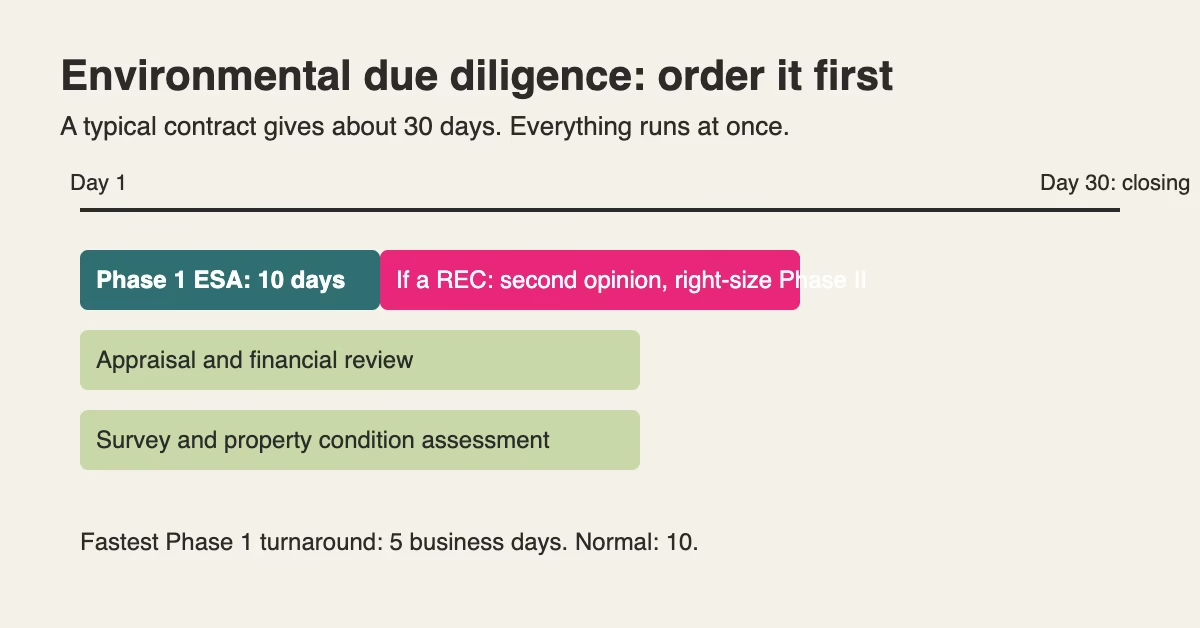
Environmental due diligence is the window in a commercial real estate contract where a buyer finds out what is under the property, and it is the step most likely to kill a deal or save one. The usual period is about 30 days. A3 Environmental Consultants (A3E) can turn a Phase 1 Environmental Site Assessment in 15 business days, or 7 if you are in a hurry. Start it first, because the environmental answer decides whether the rest of your due diligence is worth paying for.
Most people think of environmental due diligence as the thing that kills deals. It does, sometimes, and that is its job. But the bigger story is the deals it saves, and that story starts when a consultant raises a flag that turns out to be smaller than it sounds.
Why Environmental Due Diligence Exists: Contracts Do Not Have an “Oops”
A contract is a promise the government will enforce. If you break it, a court can compel you to carry it out, which is called “specific performance.” So if you sign a purchase contract with no due diligence clause, you can, in theory, be forced to buy a property even after you learn something that makes it worth less.
Because none of us can see the future, we build escape hatches into contracts. The due diligence period is the main one. You can ask for whatever timeframe you want, and you should list the kinds of due diligence you plan to do. Most contracts settle around 30 days between signing and the closing table.
The Four Types of Due Diligence in a Commercial Deal
Financial. An appraisal, the tenant leases and rent rolls, the payment history, and the interest rate a lender will offer. A professional appraisal gives you a third-party view of value, which matters most for property types that are unusual in the market.
Physical. A survey of the boundaries and a Property Condition Assessment (PCA), which explains the expected life of the mechanical systems and what they cost to replace. A 29-year-old HVAC unit with a 30-year service life is worth about 1/30th of a new one. An appraisal does not capture that, but you will pay for it.
Economic. The test that sits on top of the others: if what you found does not add up to making enough money to justify the risk, you walk away with no harm done. It is a get-out-of-jail-free card.
Environmental. Time to find out whether there is contamination in the soil or groundwater that started on the property or on a neighboring one. Nobody can see underground, and contamination comes with the property when you buy it. Environmental risk is financial risk arriving from a different direction.
How Environmental Due Diligence Protects You: The Phase 1 ESA

Assets Not Liabilities
The industry-standard tool is the Phase 1 Environmental Site Assessment. It is a preliminary report, done inside the due diligence period and before you sign for a loan. A3E meets or exceeds ASTM Standard E1527-21 on commercial and industrial property, and our reports meet the requirements of lenders and agencies such as the Small Business Administration (SBA), Housing and Urban Development (HUD) and the United States Department of Agriculture (USDA).
All of your due diligence has to run at the same time to fit inside 30 days. That is why timing matters more than anything else on this list. If the environmental consultant finds a Recognized Environmental Condition (REC), the environmental work is the thing that blows up the deal. Doing it first means you have not already spent money on an appraisal and a PCA for a deal that was never going to close. Our normal turn is 15 business days and our fastest is 7. People call us at the last minute all the time, and a last-minute call leaves no room for anything to go wrong.
5 Proven Ways Environmental Due Diligence Saves a Deal
1. Order it first, not last
The environmental report is the one most likely to change your mind. Order it before you pay for everything else, so a bad answer costs you one report and not all of them.
2. Read the findings before you agree to more work
A Phase 1 flags a concern, recommends a Phase II, and suddenly your closing is facing sampling work. As a ballpark, a Phase II ESA runs $4,000 to $11,000 and 30 to 45 days, while the deal sits and waits. The real price depends on many variables: the number of borings, their depth, the lab tests and site access. Ask whether the concern is real before you commit to it.
3. Get a second opinion on the recommendation
The buyer’s environmental professional is working for the buyer. The seller, and by extension the listing agent, often has nobody. When the buyer’s consultant recommends expensive, sometimes unnecessary work, everyone gets angry and the deal falls apart. An independent review reads the Phase 1 page by page, checks it against the records, and asks whether the Phase II can be shrunk or skipped. That is what our Defensive Environmental Review does.
4. Right-size the work that is left
Sometimes more investigation really is needed. Then the job is to scope it to the actual concern rather than leave an over-broad recommendation in place. Smaller scope means faster and cheaper, which is often the difference between closing and not closing.
5. Know what you are buying before you sign the loan
Whatever the outcome, you walk to the closing table knowing the risk you are taking, with a report your lender accepts. Read more on avoiding environmental contamination risks in a commercial real estate purchase.
A Note for Brokers and Sellers: Call Us When a Deal Hits the Skids
Yes, many buyers already have an environmental team in place. Our place is different. It is the moment a deal is on the ropes because of an environmental issue, and everyone involved knows agents do not get paid unless a deal closes. If someone in the environmental space is putting your closing at risk, call us. In our experience we have been able to talk people off the ledge and get the deal to close about 70% of the time. One saved deal is all it takes. For more on how we work with brokers, see how A3E helps CRE professionals close more deals.
What to Expect From Environmental Due Diligence
The Phase 1 ESA is the report you get at the end: a written assessment of the property and its surroundings, built to the ASTM standard and written to be accepted by your lender. Plan on 15 business days as a normal turnaround, and ask us about 7 if the clock is short. If a REC turns up, ask for the second opinion before you authorize a Phase II. Our guide to 5 steps to conduct an environmental site assessment before buying commercial property and the post on who pays for a Phase 2 ESA cover what comes next.
Project Example: A Stalled Cleanup Made Sellable in DeKalb
A downtown DeKalb, Illinois site, a former auto service center and a 1920s dry cleaner, had stalled in the Illinois EPA Site Remediation Program after the real estate crash, and contamination had moved off-site. A3E reviewed the old work with a second look, re-engaged the Illinois EPA, and finished mapping the soil, groundwater and soil-gas impacts. Instead of digging everything out, A3E closed the site with risk-based controls: barriers, land-use limits and a city groundwater ordinance A3E asked for. With closure in hand, the property could be sold and redeveloped.
- Project: Site Remediation Program closure for a stalled downtown site (2017 to 2020)
- City: DeKalb, Illinois
- Outcome: closed with risk-based controls instead of full excavation; property ready for sale and redevelopment
Frequently Asked Questions
What is environmental due diligence?
Environmental due diligence is the research a buyer does during the contract’s due diligence period to find out whether a property has soil or groundwater contamination. For commercial real estate it usually means a Phase 1 Environmental Site Assessment.
How long does environmental due diligence take?
Most contracts allow about 30 days, and all your due diligence has to fit inside that. A3E’s normal turnaround on a Phase 1 ESA is 15 business days, and the fastest is 7 business days.
What happens if the Phase 1 ESA finds a problem?
If it finds a Recognized Environmental Condition, the report may recommend a Phase II ESA. Before you agree, ask for an independent review of whether the concern is real and whether the work can be reduced. As a ballpark, a Phase II costs $4,000 to $11,000 and takes 30 to 45 days, but the price depends on the number of borings, their depth, the lab tests and site access.
Can environmental due diligence save a deal?
Yes. It kills a deal when the risk is real, and it saves one when the recommended work is bigger than the problem. In our experience we get a deal that hit the skids over an environmental issue to close about 70% of the time.
Who needs environmental due diligence?
Buyers, lenders, and the sellers and agents who want the deal to close. Anyone buying commercial or industrial property should do it before the due diligence period ends, because contamination stays with the property.
Call A3E for Environmental Due Diligence
If you need a Phase 1 Environmental Site Assessment during your environmental due diligence period, give A3 Environmental Consultants a call at (888) 405-1742 or email [email protected]. We keep your project confidential, and we will tell you plainly when a concern is real.
Reviewed by Dave McCoy, P.G., Director of Operations, A3 Environmental Consultants.

We Fix Gnarly Environmental Problems
